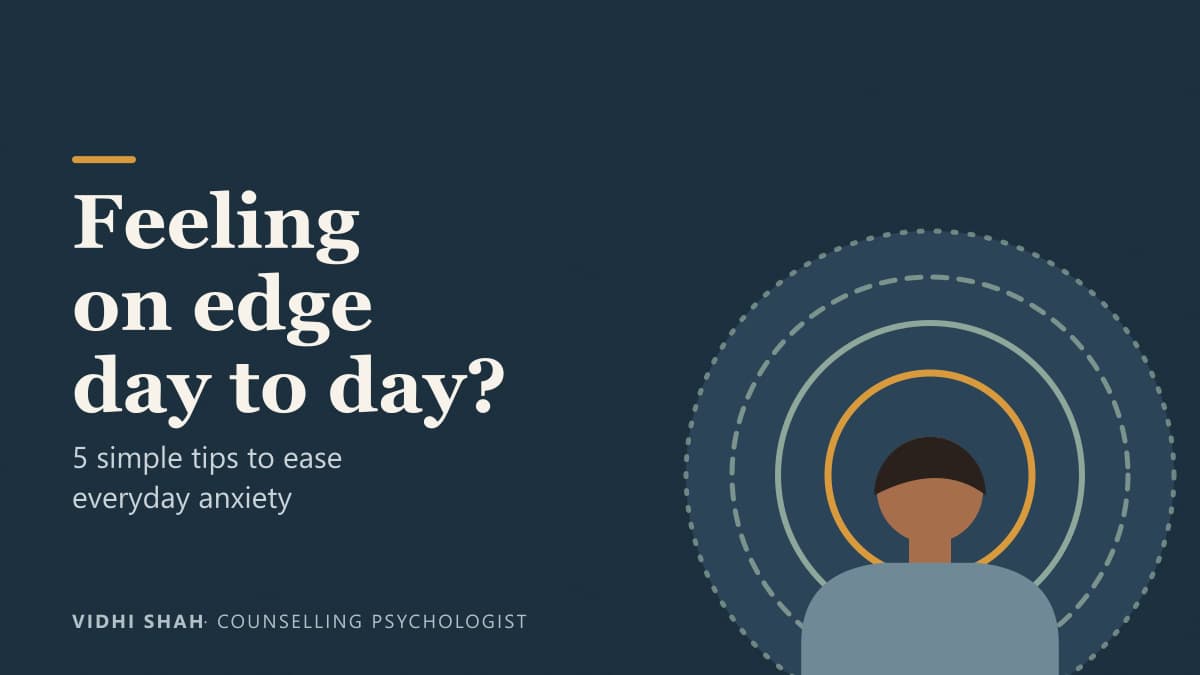
Anxiety rarely announces itself clearly. It shows up as a tight chest before a meeting you have run a hundred times, a mind that will not stop rehearsing a conversation from Tuesday, or a body that refuses to sleep even though you are exhausted. Most people who live with it are not falling apart. They are functioning — going to work, meeting deadlines, showing up for family — while carrying something that quietly drains the day.
The techniques below are drawn from cognitive behavioural therapy and from the physiology of the stress response. None of them are complicated. What matters is understanding why each one works, because a technique you understand is one you will actually use when it counts.
First, what anxiety actually is
Anxiety is a threat-detection system doing its job. When your brain registers something as dangerous, it triggers a cascade — adrenaline and cortisol release, heart rate rises, breathing quickens, blood moves to your large muscles, digestion slows. This is useful if the threat is physical and immediate.
The difficulty is that the system does not distinguish well between a physical threat and an anticipated social or professional one. A performance review, an unread message from a parent, an unpayable bill — these produce a similar physiological response to genuine danger. Your body prepares to run from something you cannot run from.
This matters practically for one reason: you cannot reason your way out of a physiological state. Telling yourself the presentation will be fine does very little when your system is already flooded. The techniques that work either address the physiology directly, or change the pattern of thinking before the flood starts.
1. Lengthen your exhale
Of everything in this article, this is the one worth learning properly.
Your heart rate rises slightly when you inhale and falls when you exhale. This is not a metaphor — it is a measurable mechanism, and it means the out-breath is the part of the breath cycle that engages the calming branch of your nervous system. Breathe in for four counts and out for six, or in for four and out for eight. The specific numbers matter far less than the exhale being longer than the inhale.
Two or three minutes is usually enough to feel a shift. Longer helps more.
The common mistake is treating this as an emergency measure. A technique you are attempting for the first time in the middle of a panic response will feel useless, because you are trying to learn a skill while your capacity to learn is impaired. Practise it daily when you are calm — in a queue, before sleep, in a rickshaw. Then it is available when you need it.
2. Name the feeling specifically
There is a consistent finding in the research on emotion: putting a specific label on what you are feeling reduces its intensity. Not describing it vaguely as stress, but naming it precisely — "I am anxious about whether my manager thinks I am coping."
The likely mechanism is that specific labelling engages the deliberate, reasoning parts of the brain, which have a dampening effect on the automatic threat response. You are not suppressing the feeling or arguing with it. You are simply identifying it, and identification creates a small amount of distance between you and the emotion.
It sounds too simple to be worth doing. Try it for a week and judge from your own experience rather than from how it reads on the page.
3. Notice what you are avoiding — and approach it in steps
This is the most important idea in this article, and the least comfortable.
Anxiety is maintained by avoidance. You dodge the thing you fear, feel immediate and genuine relief, and your brain records a lesson: that was dangerous, and avoiding it worked. The relief is precisely what strengthens the anxiety. This is why anxiety tends to expand over time — the range of things you avoid grows, and each avoidance makes the next approach harder.
The way out is graded exposure: approaching the avoided thing in steps small enough to stay with, staying long enough for the anxiety to come down on its own, and repeating it until the situation stops carrying the same charge.
If you have been avoiding speaking in meetings, the step is not delivering a presentation. It is asking one question in a meeting where you feel relatively safe. Then a slightly harder meeting. The steps should be uncomfortable but manageable — if you cannot do it, the step was too big, which is information rather than failure.
This is the core of evidence-based anxiety treatment, and it is the piece most self-help advice leaves out because it is the piece that requires discomfort.
4. Give worry a time and a place
Trying not to worry does not work. Suppressing a thought reliably increases how often it returns.
What works better is containment. Set aside a fixed twenty minutes at a consistent time — mid-evening rather than at bedtime — as your worry window. When an anxious thought arrives outside that window, note it down in a line and tell yourself you will attend to it at the scheduled time. Then return to what you were doing.
Two things tend to happen. You are not fighting the thought, so it does not rebound the way suppressed thoughts do. And when you arrive at the window, a substantial proportion of what seemed urgent has lost its force. What remains is usually a smaller, more workable list.
During the window, sort each item into one of two categories. Is this a solvable problem, or an unanswerable question? "How do I respond to this email" is solvable — decide the next action. "What if I never feel settled again" is not solvable by thinking, and more thinking will not resolve it. Recognising which kind you are holding changes what you do with it.
5. Move, and protect your sleep
These are grouped because they work on the same system and because both are routinely dismissed as too obvious to matter.
Physical movement metabolises stress hormones and gives the activation somewhere to go. It does not need to be a workout. A brisk twenty-minute walk has a measurable effect on anxiety, and the walk you actually take beats the gym session you plan and skip.
Sleep is the more consequential of the two, and the relationship runs in both directions: anxiety disrupts sleep, and poor sleep substantially lowers your threshold for anxiety the following day. This is how people end up in a self-sustaining loop. If you address only one thing, address sleep — consistent wake time, no screens for the last hour, and getting out of bed if you have been lying awake more than twenty minutes rather than training your body to associate bed with frustration.
What to do when it is already happening
The techniques above are preventive. In the middle of an acute surge, the useful move is grounding — deliberately re-anchoring attention in the present, because anxiety lives in anticipated futures.
Name five things you can see, four you can hear, three you can touch, two you can smell, one you can taste. It works not because there is anything special about the numbers but because it occupies the attentional resources that rumination requires.
If you are having a panic attack specifically, the most useful thing to know is what one is: a surge of the threat response, intensely unpleasant, and physically harmless. It peaks within about ten minutes and subsides whether or not you do anything. The fear of the attack itself is the main engine keeping the cycle going, which is why understanding it reduces frequency over time.
When self-help is not the right tool
These techniques help with anxiety that is uncomfortable but manageable. They are not sufficient for everything, and continuing to apply them to something that needs more is a way of losing months.
It is worth speaking to a professional if anxiety has persisted for more than a few weeks and is affecting your sleep, your work, or your relationships; if you are having panic attacks; if you have started avoiding things you used to do easily; or if you are using alcohol or anything else to manage it.
There is no severity threshold you need to reach first. The most common thing I hear from people who eventually start therapy is that they wish they had come earlier — usually after years of deciding they were not struggling enough to justify it.
If any of this is familiar, you can read about how anxiety therapy works, or book a session. Sessions are online, confidential, and available across India.