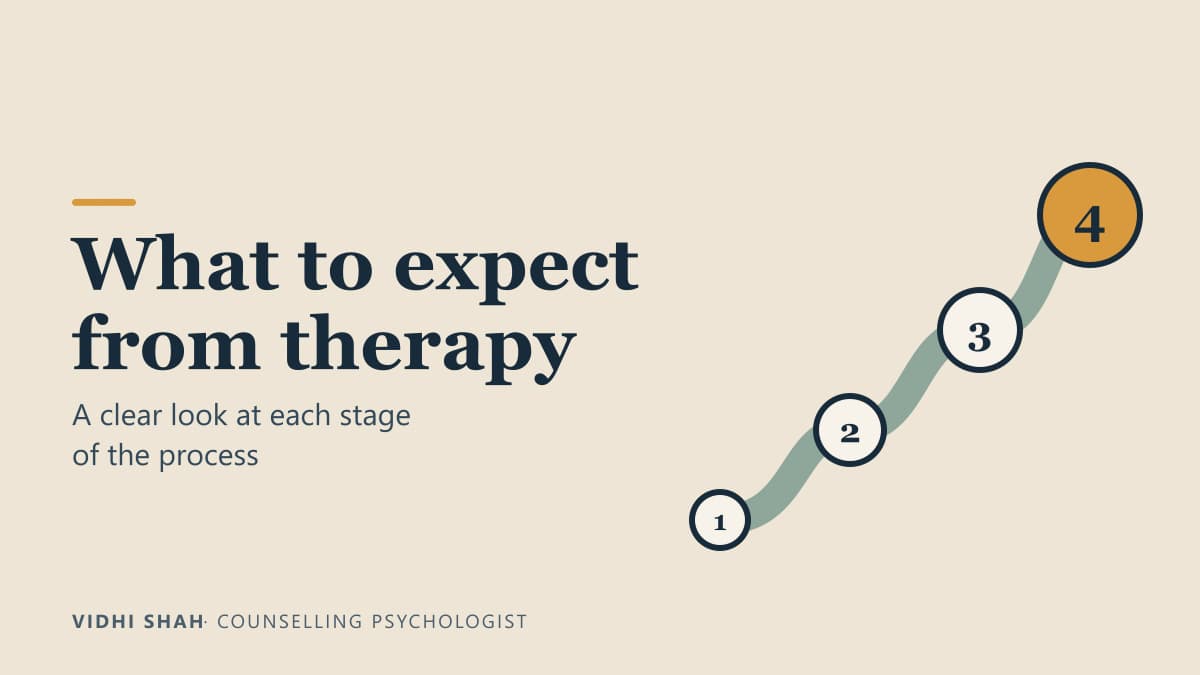
Most people arrive at a first therapy session with very little idea of what is about to happen. What they have instead is film and television, which has given them either a couch and a silent analyst or a dramatic breakthrough in the final act. Neither is accurate, and both make the real thing harder to start.
So here is what actually happens, over the whole arc rather than just the first hour.
Before you start: choosing someone
Fit matters more than most people realise. Across decades of research, the quality of the working relationship between client and therapist is one of the strongest predictors of outcome — comparable to, and sometimes exceeding, the specific method used.
This has a practical implication: a well-qualified therapist you do not feel comfortable with is a worse choice than a slightly less credentialed one you can be honest with. It is reasonable to have an initial conversation, ask how they work, and decide.
Things worth asking: what is your approach, have you worked with this kind of difficulty before, roughly how long might this take, and what happens between sessions.
The first session
Largely orientation, in both directions. You are working out whether you can talk to this person; they are building a picture of what is going on.
Expect questions about what brought you here now — the "now" matters, because something usually tipped it — along with relevant history, what you have already tried, and what you want to be different. Expect the practical frame to be covered: confidentiality and its limits, fees, cancellation, how scheduling works.
What you should not expect: a diagnosis, a treatment plan presented as a finished document, or any requirement to disclose your most difficult material immediately. You set the pace on anything hard.
Many people feel unexpectedly drained afterwards, or slightly exposed. Both are common. Some feel relief. All of these are ordinary.
Sessions two to four: getting specific
This phase turns vague description into something workable. "I have been feeling awful" becomes something with a shape: when it happens, what precedes it, what you do, what happens next.
You will probably notice your therapist asking for examples rather than accepting general statements. This is not pedantry. Patterns are only visible in specifics, and most of what is useful in therapy lives in the detail of a particular Tuesday rather than in a summary of the last two years.
By around session three or four, you should have a shared working understanding of the problem and a sense of direction. If you do not, say so — it is a reasonable thing to ask about, and a good therapist will welcome the question rather than treat it as a challenge.
The middle: where the actual work happens
This is the longest phase and the least dramatic. It usually involves some combination of examining beliefs and testing them, changing specific behaviours, understanding where a pattern originated, and practising something between sessions.
Three things about this phase are worth knowing in advance, because not knowing them is why people quit.
Progress is not linear. You will have worse weeks inside an improving trend. This is normal and it is not evidence that therapy has stopped working. If you plot mood against time, it looks like a jagged line trending upward, not a ramp.
Feeling worse after a difficult session is common. Bringing something into the open temporarily raises its intensity. It typically settles within a day or two. If it consistently does not, say so — the pacing may need adjusting, and that is useful information rather than a complaint.
There is often a point where you want to stop. Frequently just before something significant. This is worth naming out loud rather than acting on quietly by cancelling.
What is expected of you
Honesty, which is harder than it sounds. Most people manage the impression they give a therapist for at least the first few sessions — presenting a coherent version, leaving out the parts that feel shameful. This is entirely human, and the work speeds up considerably when it stops.
Attending consistently, including on weeks when you feel fine and weeks when you cannot face it. Both of those are the sessions people cancel, and both are often the useful ones.
Doing something between sessions. An hour a week is about one per cent of your waking life; the change accumulates in the other ninety-nine.
And saying when something is not working. Feedback about the therapy itself is one of the most productive things you can offer, not an act of rudeness. There is more on this in getting the most out of your sessions.
What is not expected of you
You do not have to know what you want to talk about. You do not have to cry. You do not have to disclose everything, or anything, on a schedule set by someone else. You do not have to be interesting, articulate, or grateful.
And you do not have to like every session.
How long it takes
It depends on what you are working with, and any therapist quoting a fixed number before understanding your situation is guessing.
Broadly: a focused, specific concern — a phobia, a particular decision, a recent adjustment — often resolves in eight to twelve sessions. Anxiety and depression commonly run twelve to twenty. Long-standing patterns, questions of self-worth, family dynamics, and trauma generally take longer, sometimes considerably.
You should expect an honest estimate after a few sessions, and you should expect it to be revised openly rather than left indefinite.
Ending well
Ending is part of the work, not the absence of it. It generally comes when what you came for has changed and you have the tools to handle its return.
A planned ending usually involves a few sessions spent consolidating — reviewing what changed and why, identifying your early warning signs, and deciding what you will do if things slip. That consolidation is what makes the change durable, and it is why simply drifting away is a genuine loss rather than a neutral outcome.
It is also completely acceptable to return later. Many people come back for a short course years afterwards when circumstances change. That is not a relapse or a failure; it is using a resource you know works.
When to consider changing therapists
Worth raising with them first — much of the time it is fixable, and the conversation itself is often productive.
Consider changing if you consistently feel judged, if they talk more than you do, if nothing has shifted after a substantial number of sessions and they cannot explain why, if they seem uncomfortable with what you bring, or if they dismiss your concerns about the therapy. A competent therapist will help you find someone else without taking offence.
If you are considering starting, you can read about individual therapy, look at common questions, or book a first session.