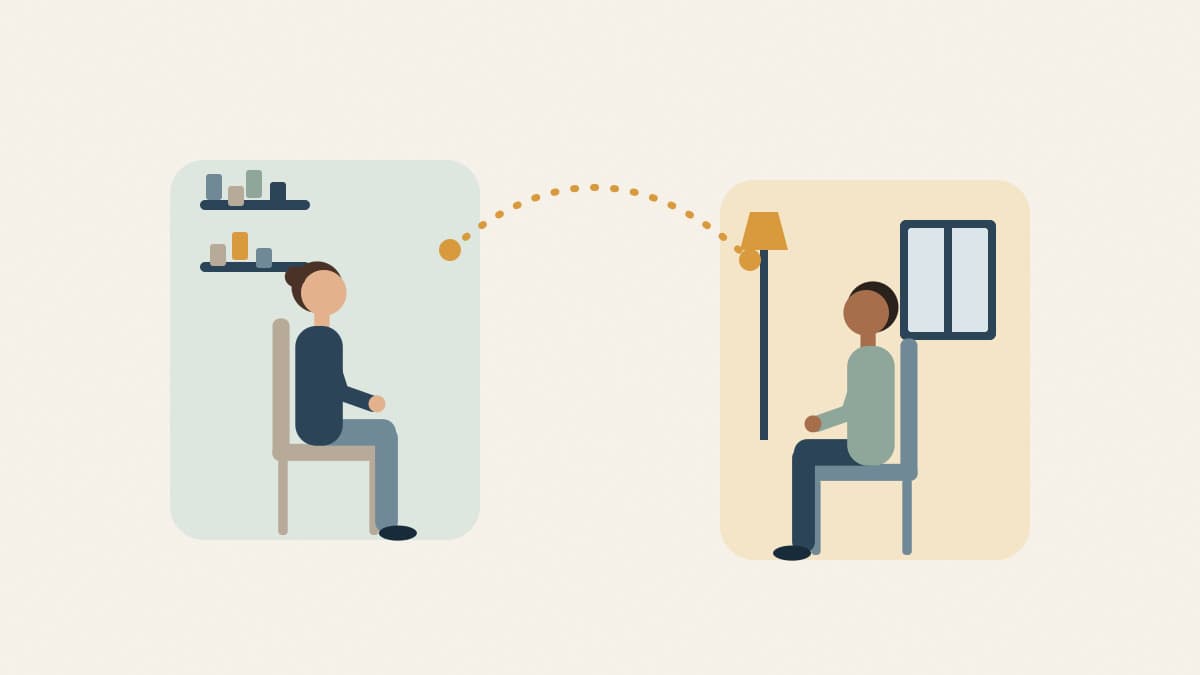
In short
Online counselling sessions with Vidhi Shah are one-to-one, 60 minutes long, and held over a secure video link, or by voice if you prefer. Fees start from ₹499 per session and the exact fee is confirmed before you book. Sessions can be held in English, Hindi, Gujarati, Marathi, Monday–Saturday, 10:00 AM – 7:00 PM IST, for clients anywhere in India and Indians living abroad.
How this service helps
Every service on this site is delivered this way: a 60-minute session with Vidhi Shah, counselling psychologist, over a secure video link. This page is the practical part — what a session includes, what it costs, when sessions run, which languages they can be held in, and what happens after you book.
What a session includes
Each session is 60 minutes, one-to-one, with Vidhi Shah herself. There is no matching step and no rotating roster: the person you book is the person you see, every time.
Sessions are held over a secure video link. Once your appointment is confirmed, a “Join session” button appears on it in your client portal, which you open with a one-time code sent to your email. There is no app to install. If you would rather not be on camera, particularly at the start, a voice session is a legitimate option rather than a lesser one.
The first session is largely orientation — what brought you here, the background that matters, and what you would like to be different. Sessions are never recorded. Brief written notes are kept for continuity, stored securely, and you can ask what is in them.
Fees
Sessions start from ₹499 for 60 minutes. The exact fee for what you are booking is confirmed with you before the session, so nothing is charged that you have not agreed to.
You can cancel or reschedule online, using the link in your booking email, up to 2 hours before a session. Closer to the time, email and it will be sorted out — the terms page has the details.
If cost is what stands between you and starting, say so when you get in touch. It is a conversation worth having rather than a reason not to begin.
When sessions run
Sessions are available Monday–Saturday, 10:00 AM – 7:00 PM IST. All times are in Indian Standard Time; if you are booking from abroad, the booking page shows the slots in IST and your confirmation states the time clearly.
Most people begin weekly and move to fortnightly once things feel steadier. That is a starting point rather than a rule, and it is agreed together.
Languages
Sessions can be held in English, Hindi, Gujarati, Marathi. You can use one language throughout or move between them, as most bilingual people naturally do — explaining context in English and saying the difficult part in the language it happened in.
To arrange a session in Hindi, Gujarati or Marathi, mention it in the message field when you book. Written communication — booking confirmations and emails — is in English.
What happens after you book
You choose a service, a date and a time on the booking page. That sends a request; you receive an email acknowledging it straight away.
Once the appointment is confirmed, you receive a confirmation email with a calendar invitation, and the link to join appears in your client portal before the session. The confirmation email includes a link to reschedule or cancel yourself if something changes.
Join a few minutes early from a private space with headphones. That is all the preparation a first session needs.
When a session like this is not the right choice
Online counselling is not appropriate in a psychiatric emergency, where there is active suicidal intent, for acute psychosis, for severe eating disorders needing medical monitoring, or where you are in immediate danger at home. These need in-person and often urgent care.
If you are in crisis right now, contact Tele-MANAS on 14416 — India's national mental health helpline, available free, around the clock, in multiple languages — or go to your nearest hospital emergency department.
If what you need falls outside what I can appropriately offer, I will tell you plainly and help you find the right service rather than taking you on.
Who this is for
- You have decided you want to talk to someone and need the practical details before booking.
- You live somewhere finding a psychologist locally is difficult, or your week cannot absorb travel to a clinic.
- You would rather not sit in a waiting room, or be seen going into one.
- You are an Indian living abroad and want a therapist who shares your context.
What you can gain
- The same practitioner every session, rather than whoever a platform assigns.
- A fee you know before you commit to anything.
- Sessions in the language you are most yourself in.
- Continuity when you travel or relocate, because the room travels with you.
What this service includes
Common questions
How much does an online counselling session cost?
Sessions start from ₹499 for a 60-minute session. The exact fee for what you are booking is confirmed with you before the session. You can cancel or reschedule online up to 2 hours before a session.
Can I have sessions in Hindi, Gujarati or Marathi?
Yes. Sessions can be held in English, Hindi, Gujarati, Marathi, and moving between languages within a session is completely fine. Mention your preference in the message field when you book.
What do I need for an online session?
A phone, tablet, or laptop with a working camera; a reasonably stable internet connection; headphones; and a private space for about an hour. Headphones matter more than people expect — they keep the therapist's side of the conversation inaudible to anyone nearby.
What happens if the connection drops?
It happens and it is not a problem. We agree a fallback at the start of the first session — usually reconnecting on the same link, or switching to a voice call. Time lost to technical trouble is not counted against your session.
Can I have sessions from outside India?
Yes. Many Indians living abroad want a therapist who understands their family and cultural context without needing it explained. Sessions are scheduled in IST, and your confirmation states the time clearly.
Are sessions recorded?
No. Sessions are never recorded. I keep brief written notes for continuity, stored securely, and you are entitled to ask what is in them.
Related services
Individual Therapy
One-on-one counselling to explore emotions, overcome anxiety, depression, or trauma in a safe space.
Learn moreAnxiety & Depression Therapy
Specialised treatment for anxiety and depression using evidence-based approaches.
Learn moreCouples Counseling
Guidance to improve communication, resolve conflicts, and strengthen relationships.
Learn more