You made the change you wanted. New job, new city, married, a child, a course finished. And instead of the settled feeling you expected, there is a persistent low-grade disorientation that you cannot justify to anyone, least of all yourself.
This is the most common and least discussed feature of life transitions: the distress is not a sign the decision was wrong. It is the predictable cost of losing a structure before a new one exists.
The shape of a transition
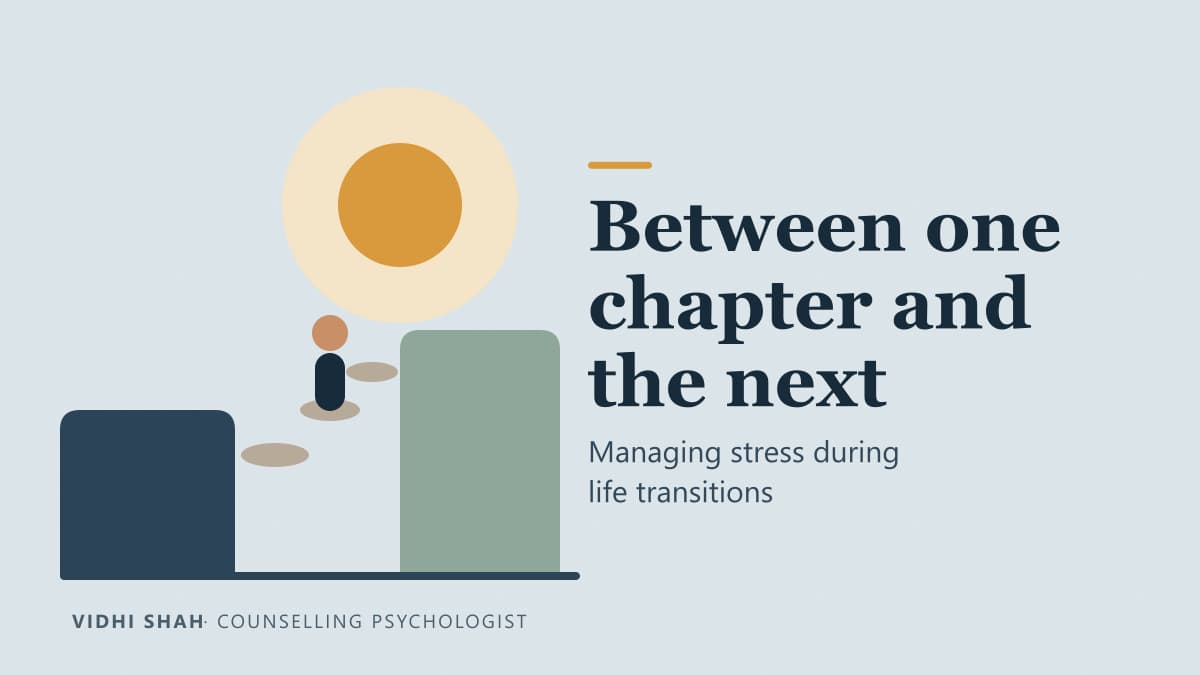
William Bridges made a distinction that clarifies most of this: change is the external event, transition is the internal reorganisation that follows. The change is over in a day. The transition takes considerably longer, and people consistently underestimate the gap.
Transitions have three parts.
An ending. Something is over — a role, a routine, a version of yourself, a set of relationships. Even in a welcome change, something is lost.
The middle. The old structure has gone and the new one is not yet real. This stretch has no landmarks and no obvious progress markers.
A new beginning. Things consolidate. This arrives later than expected and usually without any identifiable moment.
People brace for the ending. Almost nobody is prepared for the middle, which is where most of the difficulty actually lives.
The middle is the hard part
It is disorienting for structural reasons. Your routines are gone, and routine carries more psychological load than people credit. Your competence is temporarily reduced — you were good at the old thing and you are a beginner at this one. Your relationships have shifted. And you have no way to measure progress, because there is nothing yet to measure against.
This is the phase where people conclude they have made a serious mistake. Sometimes they have. More often they are in the part that feels like nothing is happening, and the feeling is a feature of the stage rather than a verdict on the decision.
Knowing this in advance changes how you interpret it, which is most of what helps.
Transitions that are supposed to be happy
Marriage. A promotion. A first child. Moving abroad. When these are hard, people rarely admit it, because the event is socially coded as fortunate and struggling with it looks like ingratitude.
But every gain carries a loss, and the losses are real:
A new city costs your entire support network at once. A promotion often costs the work you actually enjoyed, replacing it with management. A child costs autonomy, sleep, and frequently an entire prior identity. Marriage — particularly where it involves relocating into another household — can cost privacy, proximity to your own family, and a degree of independence you had not consciously valued until it was gone.
Naming the loss does not diminish the gain. Refusing to name it is usually what turns ordinary adjustment into something heavier, because you end up managing both the adjustment and the guilt about finding it hard.
Transitions you did not choose
Redundancy. A relationship ending on someone else's decision. Illness that closes a path. A forced relocation. A family situation that requires you to move or to change your plans.
These are different, and the difference is control. The loss of agency is frequently harder than the change itself.
The work here is less about deciding and more about grieving what was taken, and then locating where agency still exists. There is almost always some — usually less than you want and considerably more than the situation suggests when you are inside it.
It is worth treating an unchosen transition as an actual loss rather than a problem to be managed efficiently. People frequently skip the grief, move straight to logistics, and find the grief waiting for them eight months later.
What helps
Keep one or two things fixed
When everything changes at once, the system has nothing to hold. Deliberately preserving a small number of constants — the same wake time, the same weekly call, the same form of exercise — gives you a reference point. Choose them consciously rather than letting them all dissolve.
Name what ended
Write it down if that helps. Not just the obvious loss but the incidental ones: the colleague you spoke to daily, the walk you took, the version of yourself that job required. People are frequently surprised at the length of the list, and surprised at how much lighter it feels to have it stated rather than diffuse.
Expect it to take longer than you think
Adjusting to a relocation or a significant role change commonly takes six months to a year before things feel settled. Expecting resolution in weeks is a reliable source of unnecessary self-criticism.
Distinguish the decision from the adjustment
"This is hard" is not the same as "this was wrong". During the middle phase these feel identical. A useful discipline is to defer any reversal of a major decision until you are out of the acute phase — not to prevent you changing your mind, but to ensure the choice is made from a clearer position.
Build the new structure deliberately
Structure does not reassemble on its own. After a move, connection has to be actively constructed, and it takes far longer than most people anticipate — realistically a year or more to build the kind of friendship you left behind. Knowing that prevents the conclusion that something is wrong with you when month four is still lonely.
The transitions people underestimate
Finishing a degree. The loss of an externally imposed structure that has organised your life for two decades. Many people experience this as unexpectedly destabilising.
Career changes made under family pressure. Common in India, and particularly complicated where significant money was invested in a path chosen at seventeen. Changing direction can carry the weight of betrayal rather than choice.
Returning to India after years abroad. Reverse culture shock is frequently harder than the original move, and nobody expects it — you are supposed to be coming home.
Adult children moving out, or parents moving in. Both restructure a household and both are usually discussed only in practical terms.
Retirement. The loss of role and daily purpose, which is rarely addressed before it happens.
When to get support
Worth considering if you have been circling a decision for months without moving, if the disorientation has persisted well beyond what seems proportionate, if it is affecting sleep or work, or if you cannot tell whether you want a change or want to escape something.
Transition work is often shorter than other therapy — frequently six to ten sessions, because it is anchored to a specific period. Where it surfaces something older, such as long-standing self-doubt or a pattern of choosing what is expected over what you want, the work sometimes continues from there.
You can read about counselling for career and life transitions, or book a session.