In short
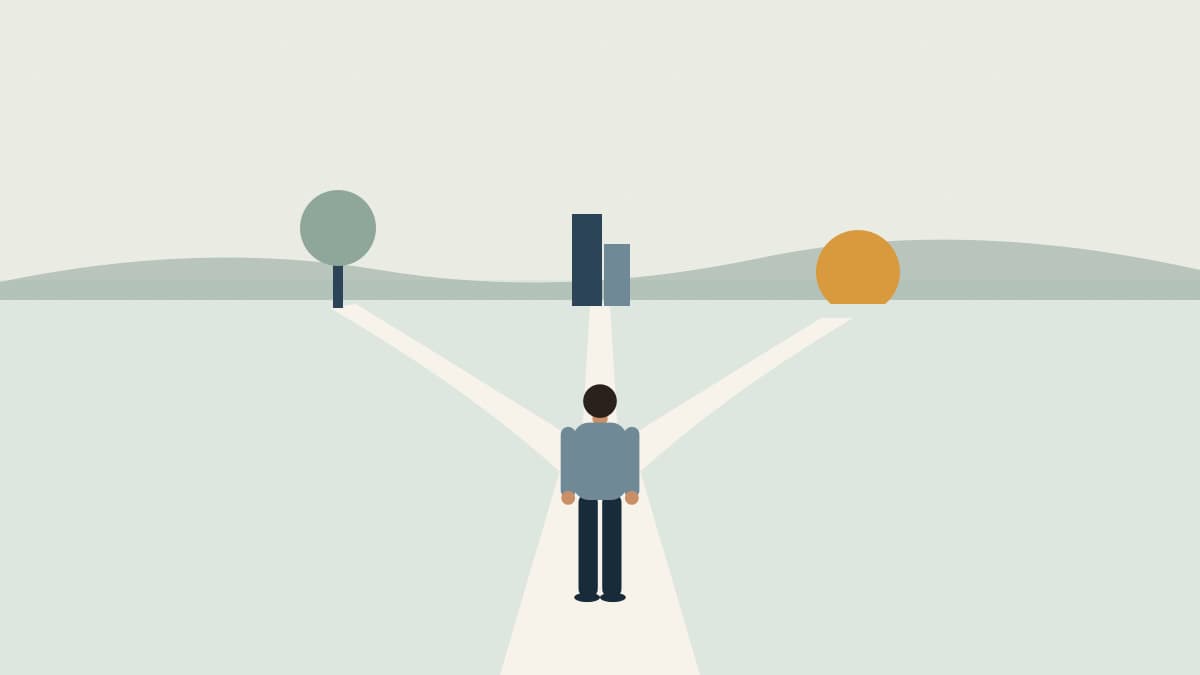
Transition counselling supports you through periods when the structure of your life is changing — a career shift, relocation, marriage, parenthood, or separation. Distress during transition is not a sign something has gone wrong; it is the predictable cost of losing a familiar structure before a new one exists. The work addresses both the practical decision and the identity question underneath it.
How this service helps
Support through the periods when the structure of your life is changing — a career move, relocation, marriage, parenthood, separation, or the loss of a role that defined you. The work covers both the practical decision and the identity question underneath it.
You might recognise some of this
- You have been circling the same decision for months without moving.
- You got what you wanted and feel unexpectedly hollow.
- You cannot tell whether you want the change or want to escape something.
- A role that defined you has ended and you are unsure who you are without it.
- Everyone has an opinion, and you can no longer locate your own.
None of this requires a diagnosis to be worth addressing.
The hard part is the middle, not the ending
Transitions have a recognisable structure: something ends, then there is an extended in-between period, then something new consolidates. People generally expect the ending to be the difficult part and are unprepared for the middle.
That middle stretch — after the old structure has gone but before the new one is real — is where most of the distress lives. It has no landmarks, no clear progress markers, and it is where people conclude they have made a terrible mistake. Frequently they have not; they are simply in the part that feels like nothing is happening.
Knowing this in advance changes how you interpret it. Discomfort becomes a stage rather than a verdict on your decision.
Career decisions, and the question underneath them
People arrive wanting help deciding whether to take the job, leave the field, or start something of their own. That decision is usually not the actual problem — the actual problem is that they cannot tell which parts of their reluctance are genuine and which are fear, obligation, or somebody else's ambition.
For clients in India there is often a specific weight to this: a career chosen at seventeen under family pressure, significant money invested in a particular path, and a strong sense that changing direction would be a betrayal rather than a choice. That deserves to be taken seriously rather than dismissed as something to overcome.
The work is separating the strands — what you want, what you fear, what you owe, and what you have simply never questioned — until the decision becomes yours rather than a reaction.
Transitions that are supposed to be happy
Marriage, a promotion, a first child, moving abroad. When these are hard, people rarely admit it, because the event is socially coded as fortunate and struggling with it looks like ingratitude.
But every gain carries a loss. A new city costs you your existing support network. A child costs you autonomy and, often, an entire prior identity. A promotion may cost you the work you actually enjoyed. Naming the loss does not diminish the gain, and refusing to name it is what tends to turn ordinary adjustment into something heavier.
When you cannot choose
Not every transition is chosen. Redundancy, a forced relocation, a relationship ending on someone else's decision, illness that closes off a path — these arrive without consent, and the loss of control is often harder than the change itself.
The work here is different. It is less about deciding and more about grieving what was taken, and then finding where agency still exists. There is almost always some — usually less than you want and considerably more than despair suggests.
Who this is for
- You are facing a career decision you keep deferring.
- You have relocated and have not found your footing.
- A major life change — marriage, parenthood, separation — has unsettled you.
- You want to decide deliberately rather than by drift or by pressure.
What you can gain
- Clarity on what you actually want, separated from what is expected.
- A decision you can hold without constant second-guessing.
- Tools for the instability of the in-between period.
- A sturdier sense of identity that does not rest on one role.
What this service includes
Before you book
- Fees
- From ₹499 per 60-minute online session. The exact fee is confirmed before your session.
- When
- Monday–Saturday, 10:00 AM – 7:00 PM IST. Online, from anywhere in India or abroad.
- Languages
- Sessions in English, Hindi, Gujarati, Marathi. Counselling in Hindi, Marathi and Gujarati.
- After you book
- You get an acknowledgement straight away; your request becomes an appointment once it is accepted, and you get a confirmation email then. You join from your client portal. You can change or cancel online up to 2 hours before a session. How online sessions work.
Counselling is not an emergency service. If you are in crisis or thinking about ending your life, contact Tele-MANAS on 14416 (free, 24x7, in multiple languages) or go to your nearest hospital emergency department.
Common questions
Is this career counselling or therapy?
Therapy, with career content. I do not administer aptitude tests or map job markets — a career counsellor does that better. What I work on is the psychological layer: fear, identity, obligation, and the pattern that has kept you stuck. Many people benefit from both, in sequence.
Can you tell me what I should do?
No, and a decision handed to you by someone who has known you for a few hours will not hold under pressure. What sessions produce is enough clarity that the answer stops being ambiguous — which is a more durable result than a recommendation.
I feel guilty for struggling with something good. Is that common?
Very. Positive transitions carry real losses, and the social expectation of gratitude makes those losses harder to acknowledge. Being able to say it out loud, somewhere it will not be judged, resolves a surprising amount on its own.
How many sessions does this usually take?
Transition work is often shorter than other therapy — frequently six to ten sessions, because it is anchored to a specific period. If it surfaces something older, such as long-standing self-doubt, the work sometimes continues from there.
I have moved cities and feel isolated. Can counselling help?
Yes, and it is a common reason people start. Relocation removes your entire support structure at once, and rebuilding takes far longer than most people anticipate. The work usually covers both the grief of what you left and the practical business of building connection somewhere new.
Related services
Stress Management
Therapeutic techniques to manage stress, build resilience, and restore balance.
Learn moreIndividual Therapy
One-on-one counselling to explore emotions, overcome anxiety, depression, or trauma in a safe space.
Learn moreSelf-Esteem & Confidence Building
Build self-confidence, improve self-image, and develop a healthier relationship with yourself.
Learn more